
Contemporary narratives of ADF families focus on the sacrifices families make, the support they provide ADF members, and the role that plays in defence capability. After decades of peace, followed by wars on foreign shores, the “homefront” has become narrowly defined as the homes of ADF families. However, during times of war and other national emergencies, the homefront is much broader. It is healthcare, education, defence industry, social services, transport, supply chains, cybersecurity and so much more – all industries in which you might find ADF partners. However, as a consequence of military lifestyle factors, many partners are amongst the millions of Australians underutilised in the labour force. This represents a threat to ADF recruitment, retention and capability, but also to national resilience. We need only look at what happened in World War II (which ended 80 years ago next month) and the Covid 19 pandemic, and what is happening in Ukraine, to understand the importance of the national home front. These events offer valuable lessons about how to prepare and mobilise the workforce for war. ADF partners sit at the juncture between the military and civil systems. In this volatile global environment, the government must understand the vital roles partners do and can perform, and mitigate barriers to ADF partners’ labour force participation in the interests of national security.
In 2017 I was concerned that the portrayal of defence partners as “guardians of the Homefront” was a risk to improving partner employment outcomes. Today, I believe the issue is not that partners are guardians of the homefront, but that the extent of the homefront, and the role of partners, is not well enough understood by defence leaders and policy makers.
The current narrative about Australian defence and veteran partners portrays them as caregivers of children, a source of support for their service member, household managers during deployments, and the caregivers of injured or ill veterans. As such, when defence leaders talk about the homefront they are usually referring to the homes of ADF and veteran families. It is not surprising that the narrative focuses on support – the vast majority of partners are women, who are often seen and relied upon as caregivers. As Canadian researcher Leigh Spanner writes “in order to function, militaries rely on spouses, most often wives, to undertake the majority of domestic labour, suspend their own careers, and relocate willingly for new postings”; a sentiment supported by data on Australia’s defence families.
This focus on support is an accurate but incomplete portrayal of the role partners perform. The vast majority of partners are employed outside the home in occupations including professionals, community and personal service workers, clerical and administrative workers, managers, technicians and trades workers, sales workers, and machinery operators and drivers. However, the military lifestyle (primarily relocation and the uneven distribution of domestic and caring work in ADF families) results in career sacrifices that can lead to partner unemployment, underemployment, skills misalignment and poor quality work.1 This has implications for financial security and health and wellbeing of ADF families, which in turn has serious implications for ADF recruitment and retention2 and defence capability. However, it is not only the ADF that suffers as a result – the evidence indicates that partners are amongst the millions of Australians who are underutilised in the labour force i.e. unemployed, underemployed or not in the labour force but want to work. This has implications for the economy, social cohesion, and therefore national resilience.
The Covid-19 pandemic demonstrated the need for a national resilience strategy to mitigate the risks to Australia’s critical national systems. When the pandemic hit in 2020, military personnel in Australia were relied upon to assist with containment measures. Families were thanked by General Angus Campbell (then Chief of Defence Force) for the “continuous sacrifices that you and your family make in supporting us“. 3But the Chief also acknowledged that it was a particularly stressful time for “those who are employed in essential services like healthcare, education and some retail sectors like pharmacies and supermarkets” and he reassured families that he had asked his command team “to support, wherever possible, our families members who are in health and support roles in protecting your community“. Health and education professionals make up the biggest cohorts of professionals amongst the nearly 50% of partners in professional roles. However, anecdotally partners reported difficulties in being able to perform their professional roles due to the demands that military life imposed during the pandemic.
The Prime Minister identifies national resilience as fundamental to our national security. Dialogue at a national security event last year emphasised that “the direct threat to Australia is broad and not narrowly focused on what the Australian Defence Force can do. A sustainable force and a resilient Australia are beyond the scope of narrowly considered defence investments in a ready force. They are all of government and all of society challenges”. Likewise, the ADF should recognise that the “homefront” extends beyond the homes of ADF personnel – it also includes the industries and occupations in which ADF partners work.
At the national security event, former Secretary of Home Affairs, Michael Pezzullo told Australia’s security leaders that Australia needs a ‘war book’ to “deal with the entire span of civil defense and mobilization which would be required to move to a war footing“. The previous Australian ‘War Book’, produced in 1956 to facilitate the transition from peace to war, identified the measures that must be taken in civilian fields including food and agriculture, works and buildings, shipping, rail and road transport, fuel and power, financial and economic policy and manpower. These domains, and those that have emerged since, define the national homefront.
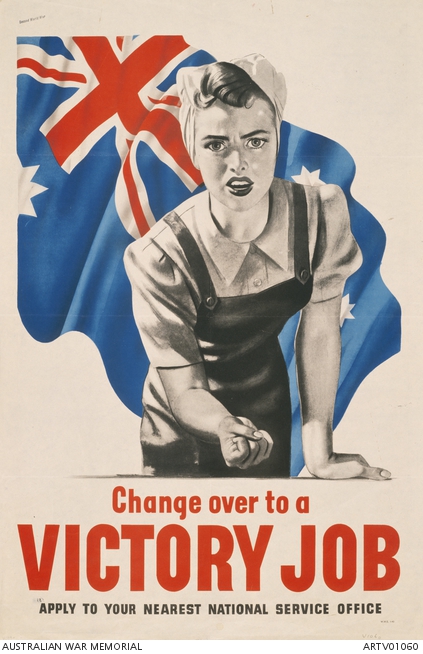
The ‘War Book’ included measures needed to control “manpower” to achieve the best possible use of this limited resource during war,4 although the term ‘manpower’ was as outdated then as it is today. In both the World Wars women filled essential roles on the homefront. In World War II, when it became apparent that Australia could not meet its wartime obligations with the existing workforce, the government enacted powers under the National Security Act to allow Australian women to perform many of the roles that had been vacated by the men who went to serve in uniform.These jobs included making weapons, ammunition, tanks and airplanes, as well as agricultural jobs, finance and public service roles, and more traditional roles such as nursing. At the aircraft factories in Victoria, the criteria for women’s employment included women who were sole breadwinners, women whose husbands were away on war service, or women who sought skilled training. Women performed these roles whilst still caring for their children, the elderly, and those who returned home from war injured or ill. By 1943 there were more women in the workforce than ever before, including many married women whose husbands were in the forces.
That women filled vital roles during the World Wars, and that women today participate in the workforce in record numbers, is not a coincidence. Although most women returned to their traditional homemaker roles at the end of WW2 , their wartime participation in the workplace set off long-term changes. In 2025 Australian families (including ADF families) expect to be dual income.
Whilst geopolitical circumstances have changed dramatically since the 1940s and ’50s, national resilience remains the foundation on which our ability to respond and survive to threats rests. This includes the same sentiment expressed in 1956 – ensuring that we “achieve the best possible use during the war of men and women for the military and civilian war effort“.The current war in Ukraine provides valuable insights into national resilience in contemporary wartime. A special issue of The European Journal of Social Science Research reports that “(t)he ongoing war has not only tested Ukraine’s ability to withstand external aggression but has also reshaped its social fabric, institutional structure, and civic engagement in ways that offer critical insights for global debates on democracy, security, and collective agency in crisis settings”. Ukraine’s entire economy has been reorganised around the war effort. Their economic resilience in the face of the Russian invasion is impressive. But as the OECD reports, war mobilisation and displacement have created significant labour shortages amongst the male dominated workforce. As was the case in Australia, Britain and the United States in WWII, women in Ukraine are at the forefront of Ukraine’s resilience and recovery, filling roles left vacant by those who are serving in, or have been lost to, the war and holding communities together. In some cases, this has required lifting restrictions on the type of work women can do.
Fortunately, unlike Ukraine or in 1956, Australia does not have to enact legislation or adjust industrial relations policies in respect of “employment of women”. However, both WWII and Ukraine offer insights into other barriers which must be anticipated and overcome. National emergencies and war uncover and entrench existing structural inequities that can impede a country’s ability to respond to war and crises. In WWII the Australian government was unprepared for the country’s reliance on women to meet workforce needs. It was only after the Japanese attack in 1941 that Curtin’s War Cabinet decided women would be employed in industries to replace men away on military service.5 Between 1939 and 1943 women’s participation in the workforce increased by 31%. Yet, societal attitudes and the infrastructure to support women’s participation was lacking. Perceptions, prejudice and self-interest proved to be barriers to women’s participation. There were fears of competition for men’s jobs from low-paid female workers, doubts that women could perform “men’s work”, that female-dominated industries would lose workers to better-paid jobs, and concerns that women would lose their femininity. Mollie Bayne detailed the inadequacy of childcare availability during the war writing “How inadequate this peace-time provision is in war-time is evident.” The Australian government engaged in negotiations with employers and trade unions over hiring and wages, and launched a propaganda campaign enticing women into ‘victory jobs’, claiming that they would find it no harder, and perhaps easier, than their house job. Federally subsidised childcare in Australia has its roots in WWII, with the Federal Government, along with independent groups, providing facilities so that mothers could be employed in war efforts.6 Similarly, in Ukraine, the war has required dialogue between state and non-state actors to increase women’s workforce ratios. Investments have been made in training in high-demand occupations, and empowerment campaigns such as “Of Course You Can” have been launched. Currently in Ukraine, the closing of childcare centres has increased the unpaid domestic burden on women and is hindering their participation in the workforce. In response, government and employer organisations are seeking ways to meet their workforce needs by partnering with the International Labour Organisation on childcare solutions.
Today, military, social and cultural norms present barriers to sustainable and meaningful ADF partner employment. These include high rates of mobility,7 the location of bases located in areas with limited employment opportunities, claims of employer bias against partners, outdated recruitment and human resource policies processes, a reliance on partners as caregivers8, challenges managing work and the household in the ADF member’s absence, and difficulties accessing suitable childcare. The impact of military life on contemporary ADF families has been consistently identified for almost forty years, yet it has grown to be one of the top issues of concern for contemporary ADF families. Current employment support is inadequate in addressing the multiple, interrelated barriers to employment. In some instances the support has reduced over time.9 The words of Sue Hamilton in her 1986 landmark report ‘Supporting Service Families’ still ring true – many ADF families are either reluctant one income families or at best precarious two income families.
Whilst ADF and veteran partners make up only a small percentage of the Australian population, their underutilisation in the labour force is not in the national interest. This isn’t simply a matter of unemployment rates. It is about supporting and harnessing the skills, adaptability, service-mentality and leadership of the partner workforce to help boost Australia’s productivity and resilience – in addition to creating healthy, strong and secure ADF families to facilitate capability.
The need to enable the partner workforce was clearly identified in 1944, has been reiterated in Ukraine, and could reasonably be expected should Australia enter a regional conflict in the future. A concerted and collective effort by many stakeholders with strong government leadership is required. In the absence of a national resilience and security strategy it is incumbent on Defence leadership to appreciate how their policies and practices impact other national systems. It is also incumbent on them to demonstrate strong leadership to other government departments and the private sector on the importance of minimising barriers to employment and realising the value of ADF partners in the labour force. This aligns with the National Defence whole-of-nation approach and would have the added benefit of engaging the Australian public in understanding and supporting national security efforts.
Military partners sit at the juncture between military and civil systems – investment into addressing partner employment challenges is shared across (to borrow from NATO) core defence expenditure and associated critical infrastructure and civil resilience. Australia must use the limited time available to act on the evidence and the lessons from history and Europe to invest in ADF partner employment and build the skilled workforce, infrastructure and strong systems we need on both the front line and on the national homefront.
- Also see 1986 Hamilton Report, 1991 ADF Families Census report, 1994 ADF Families and Mobility Dislocation Study, ANAO 2009 ADF Families Survey, 2011 Defence Census, 2015 Defence Census, 2015 ADF Families Survey, 2017 ADF Families Survey, 2019 ADF Families Survey, 2019 Defence Census, 2022 ADF Families Survey. ↩︎
- The relationship between partner employment and recruitment and retention was established by Sue Hamilton in her 1986 report ‘Supporting Service Families’. ↩︎
- Chief of Defence Force letter to ADF families dated 23 April 2020 ↩︎
- See p4, chapter XVI of the Australian War Book 1956. ↩︎
- S. McIntyre (2013). Women’s Leadership in War and Reconstruction. Labour History 104 pp 65-80. ↩︎
- The federal government withdrew its funding after the war, and childcare was not federally subsidised until 1972. ↩︎
- Unpublished data from the 2023 ADF Census reports that over 80% of partners were out of work for some period between 2019 and 2023 as a result of a defence relocation. Of those who found work, nearly half were earning less in the new job. ↩︎
- The 2023 ADF Census reports that almost half of ADF members with children relied upon their spouse to provide childcare. ↩︎
- For example, Defence (via Defence Community Organisation) used to liaise with local employers to facilitate employment opportunities in areas in which ADF bases were located. ↩︎
Image courtesy of the Australian War Memorial.